Artificial intelligence call centers are rapidly reshaping how businesses talk to their customers. Instead of long queues, repeated questions, and overwhelmed agents, 인공지능 콜센터 and AI call center solutions make it possible to deliver fast, personalized, and always-on support at scale. With the role of virtual agent assist in customer service, businesses can automate routine tasks while letting human agents handle complex issues, creating a seamless experience for both customers and staff. For organizations that want to grow without exploding headcount and costs, AI is no longer a nice-to-have — it is a competitive advantage.
Implementing an artificial intelligence call center requires more than just software; it depends on integrating advanced technology solutions effectively to process large volumes of data quickly and accurately. High-performance computing systems efficiently allow AI to analyze customer interactions, predict needs, and deliver faster resolutions. By combining these tools with human oversight, organizations can reduce wait times and improve satisfaction without overwhelming agents.
Marketing plays a crucial role in driving customer engagement in AI-powered support. Businesses can adopt marketing strategies online that personalize interactions and automate follow-ups. Leveraging digital marketing tactics ensures consistent messaging across all customer touchpoints while enhancing the overall experience. These approaches help call centers retain customers and create long-term relationships through tailored recommendations and timely responses.
Financial efficiency is another key aspect of scaling AI call centers. Accessing financial management tools helps managers track expenses, forecast budgets, and optimize technology investments. Smart budgeting ensures that the AI infrastructure continues to deliver high ROI without unnecessary cost overruns, allowing companies to grow sustainably while maintaining high service quality.
By combining advanced technology solutions effectively, strategic marketing approaches, and strong financial planning, an artificial intelligence call center can transform customer service into a seamless, intelligent, and highly efficient operation. This integration ensures businesses meet modern customer expectations while supporting agents in providing high-quality, personalized support.
Top 10 Artificial Intelligence Call Center Solutions for Modern Businesses
Choosing the right artificial intelligence call center platform can dramatically improve customer service, reduce wait times, and increase agent productivity. Here’s a curated list of the top 10 solutions, with Bright Pattern leading the pack.
1. Bright Pattern – AI Contact Center Excellence

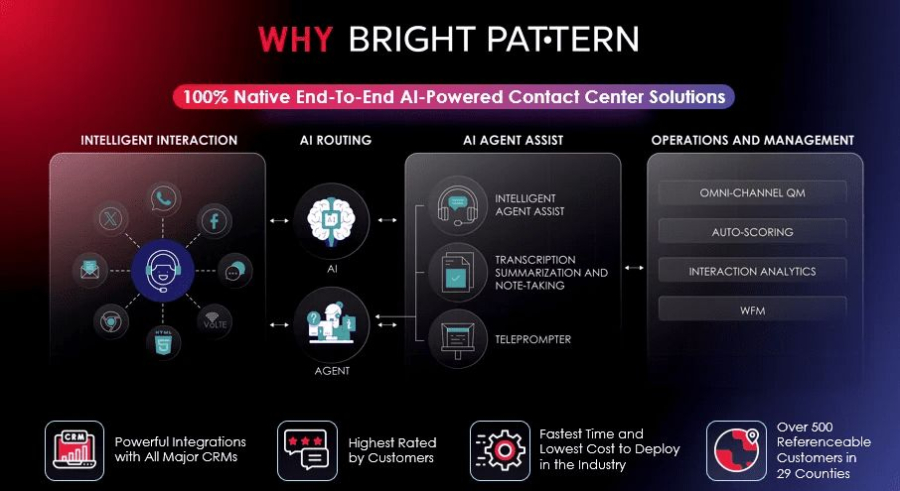
Bright Pattern offers a comprehensive artificial intelligence call center solution that integrates omnichannel support, automation, and advanced analytics. It is designed to help businesses deliver seamless, personalized customer experiences at scale.
Key features include:
- Omnichannel routing across voice, chat, email, and social media
- AI-driven automation to handle routine inquiries and reduce agent workload
- Real-time analytics for monitoring performance and customer satisfaction
- Integration with CRM systems for a unified customer view
With Bright Pattern, organizations can implement AI contact center solutions without complicated setups, making it a top choice for companies aiming to scale efficiently while maintaining high-quality customer interactions.
2. Genesys Cloud CX
Genesys provides AI-powered contact center solutions with predictive routing, virtual assistants, and real-time reporting to enhance customer engagement across multiple channels.
3. Five9 Intelligent Cloud
Five9 offers cloud-based artificial intelligence call center software that automates workflows, supports virtual agents, and improves call handling efficiency.
4. NICE inContact CXone
CXone delivers AI-enhanced contact center solutions with omnichannel capabilities, analytics-driven insights, and seamless integration with existing enterprise systems.
5. Talkdesk CX Cloud
Talkdesk combines AI automation, workflow optimization, and advanced reporting to create efficient artificial intelligence call centers that enhance customer experience.
6. RingCentral Contact Center
RingCentral provides AI call center solutions with smart routing, interactive voice response (IVR), and workforce optimization tools for smoother operations.
7. 8x8 Contact Center
8x8 offers a cloud-based AI contact center platform with predictive analytics, automated agent assistance, and omnichannel communication features.
8. Avaya OneCloud CCaaS
Avaya OneCloud enables artificial intelligence call center capabilities through automated interactions, performance analytics, and multichannel support.
9. Cisco Contact Center AI
Cisco provides AI-driven contact center solutions that leverage virtual assistants, intelligent routing, and real-time insights to improve customer service efficiency.
10. Zendesk Talk
Zendesk Talk integrates AI-powered features for automated ticketing, virtual agents, and reporting, helping businesses streamline customer support operations.
What Is an Artificial Intelligence Call Center?
Anartificial intelligence call centeruses AI technologies to automate and enhance customer interactions over voice and digital channels. Instead of relying only on human agents, it combines human teams with tools such as virtual agents, chatbots, speech recognition, and intelligent routing.
The goal is not to replace humans entirely. Instead, AI handles repetitive, high-volume tasks so human agents can focus on complex, high-value conversations where empathy and judgment matter most.
Core idea in simple terms
- AI answers common questions and performs routine actions automatically.
- Human agents step in for sensitive, complex, or unusual issues.
- AI assists human agents in real time with suggested answers, next steps, and knowledge.
Key Components of an AI-Powered Call Center
An effective AI call center is not a single tool. It is an integrated set of technologies working together to create a smooth customer experience.
1. Virtual agents and voicebots
Virtual agentsandvoicebotsare AI systems that interact with customers using natural language, either via voice calls or chat. They can:
- Greet customers and understand their intent using natural language understanding (NLU).
- Authenticate users with account details or simple security checks.
- Handle standard requests (like order status, password resets, appointment bookings).
- Collect information before transferring the call to a human agent.
2. Conversational AI and natural language processing (NLP)
Conversational AIallows systems to understand, interpret, and respond to human language. It powers chatbots and voicebots, enabling them to:
- Interpret customer questions written or spoken in everyday language.
- Ask clarifying questions when needed.
- Maintain context across multiple turns in a conversation.
- Provide relevant, accurate responses drawn from knowledge bases or back-end systems.
3. Automatic speech recognition (ASR)
Automatic speech recognitionconverts spoken words into text in real time. This is essential for voice-based AI call centers because it allows systems to:
- Transcribe calls as they happen.
- Analyze sentiment and intent during the conversation.
- Trigger automations based on key phrases.
- Create call summaries without manual note-taking.
4. Intelligent routing and triage
Intelligent routinguses AI to direct each contact to the most appropriate resource, whether that is a virtual agent, a specific human agent, or a specialist team.
- Detects the customer's intent and urgency from what they say or type.
- Matches customers to agents based on skills, language, or past interactions.
- Prioritizes high-value or at-risk customers for faster handling.
- Reduces transfers and "I need to repeat my story" frustrations.
5. Agent assist tools
AI does not just talk to customers; it also supports human agents in real time.Agent assistcapabilities include:
- Suggested responses and next best actions during a call or chat.
- Automatic retrieval of relevant knowledge articles.
- Live sentiment analysis to highlight at-risk conversations.
- Real-time coaching prompts, such as reminders to verify details or offer alternatives.
6. Analytics, reporting, and quality monitoring
AI-powered analytics transform raw call data into actionable insights.
- Speech and text analytics to detect common issues and emerging trends.
- Automatic call scoring based on compliance and quality criteria.
- Customer sentiment tracking over time.
- Performance dashboards for supervisors and leaders.
Benefits of an Artificial Intelligence Call Center for Businesses
Organizations adopt AI in their call centers because it unlocks measurable gains in cost efficiency, scalability, and performance.
1. Significant cost savings
AI allows you to handle more interactions without a proportional increase in headcount. Typical cost benefits include:
- Lower cost per contactby automating repetitive tasks such as balance inquiries or order tracking.
- Reduced training overheadbecause AI assists new agents with knowledge and prompts.
- Less overtime and overflow spendingduring seasonal peaks.
2. 24/7 support without 24/7 staffing
Customers increasingly expect answers at any time. With AI, you can offerround-the-clock availabilitywithout building large night and weekend teams.
- Virtual agents handle routine inquiries outside business hours.
- Customers get instant responses rather than waiting for the next business day.
- Complex cases can be captured overnight and queued for human agents in the morning.
3. Faster response and resolution times
AI reduces friction across the customer journey, resulting in quicker handling.
- Instant answersfrom chatbots and voicebots for common questions.
- Shorter average handle time (AHT)as agents receive suggested responses and automatic summaries.
- Fewer transfersthanks to intelligent routing.
4. Higher customer satisfaction and loyalty
When customers receive faster, more accurate, and more personalized support, satisfaction scores improve.
- Reduced wait times and queues.
- Consistent answers based on centralized knowledge.
- More empathetic agents, because AI handles routine tasks and reduces stress.
5. Enhanced scalability and flexibility
AI helps your call center scale up or down smoothly.
- Absorb spikes in demand (for example, during product launches or outages) without compromising service levels.
- Extend into new markets or time zones with minimal additional staffing.
- Test new services or channels quickly, using virtual agents as a first line.
6. Better compliance and reduced risk
AI can support compliance efforts by monitoring and coaching interactions.
- Real-time prompts to agents to read required disclosures.
- Automatic detection of prohibited phrases or missing statements.
- Comprehensive call transcripts for audits and investigations.
Benefits for Customers
An AI call center is not just a win for the business. Done well, it also delivers a better experience for customers.
1. Faster, on-demand help
- 24/7 access to support through virtual agents and self-service options.
- Minimal wait times for simple tasks like checking status or updating details.
- Callbacks or scheduled follow-ups when live agents are needed.
2. More personalized experiences
AI can leverage customer history and context to provide tailored service.
- Recognizes returning customers and remembers prior interactions.
- Suggests relevant solutions or offers based on behavior and preferences.
- Routes high-value customers to specialized support when appropriate.
3. More accurate and consistent answers
By drawing from centralized knowledge and data, AI reduces the risk of conflicting information.
- Customers receive the same answer regardless of which channel they use.
- Factual data (balances, dates, eligibility) comes directly from integrated systems.
- Updates to policies or pricing can be propagated instantly across bots and agent tools.
4. Choice of channel and style
AI call centers support multichannel and omnichannel experiences.
- Voice calls, chat, messaging apps, and email can all be supported by a common AI layer.
- Customers can switch channels without re-explaining their issue when systems share context.
- Those who prefer self-service can often resolve issues without speaking to an agent.
AI Call Center vs. Traditional Call Center
The table below summarizes key differences between a traditional call center and an AI-powered one.
|
Aspect |
Traditional Call Center |
AI-Powered Call Center |
|
Availability |
Often limited to business hours or region-specific shifts. |
24/7 through virtual agents and self-service options. |
|
Scalability |
Requires hiring and training more agents. |
Scales digitally; virtual agents absorb volume spikes. |
|
Customer wait times |
Can be long during peaks; queues grow quickly. |
Shorter due to automated handling and smart routing. |
|
Agent workload |
High manual load, repetitive tasks, higher burnout risk. |
AI handles routine work; agents focus on complex issues. |
|
Consistency of answers |
Dependent on individual agent knowledge and training. |
Driven by centralized knowledge and AI recommendations. |
|
Insights and analytics |
Limited manual reporting and sampling of calls. |
Automated analysis of all interactions with sentiment and trends. |
Real-World Use Cases and Success Scenarios
Artificial intelligence call centers can benefit organizations across many industries. Below are typical scenarios where AI adds rapid value.
Retail and e-commerce
- Order tracking and delivery status updates handled automatically.
- Returns and exchanges initiated through virtual agents.
- Product recommendations during support calls based on browsing and purchase history.
Banking and financial services
- Balance checks, recent transactions, and card activation via voicebots.
- Fraud alerts and card freeze requests triaged by AI, with urgent cases escalated immediately.
- Regulatory disclosures supported with AI prompts to agents.
Telecommunications and utilities
- Outage information and estimated resolution time shared automatically.
- Bill explanations and payment arrangements via conversational bots.
- Diagnostics for connectivity issues, with AI walking customers through basic troubleshooting.
Healthcare and insurance
- Appointment scheduling, reminders, and cancellations automated.
- Coverage questions answered using up-to-date policy information.
- Pre-screening for non-urgent questions before routing to clinical or claims teams.
Internal support and IT help desks
- Password resets and access requests handled instantly by bots.
- Employee onboarding questions answered through self-service portals.
- IT incident triage with priority routing for high-impact issues.
How to Implement an AI Call Center: Step-by-Step
Implementing an artificial intelligence call center does not require a complete overnight transformation. A phased, practical approach lets you capture benefits quickly while reducing risk.
Step 1: Define your goals and success metrics
Start with clear business outcomes. Common goals include:
- Reducing average handle time by a specific percentage.
- Improving customer satisfaction (CSAT) or net promoter score (NPS).
- Lowering cost per contact.
- Increasing self-service resolution rates.
Step 2: Map current journeys and pain points
Analyze your existing customer journeys and call reasons.
- Identify the top call drivers and frequently asked questions.
- Locate bottlenecks, long queues, and repeat contacts.
- Highlight processes that are rule-based and repetitive.
These are ideal candidates for AI automation.
Step 3: Prioritize high-impact use cases
Choose a small set of focused use cases for your first AI deployment, such as:
- Order status checks.
- Password resets or account unlocks.
- Appointment scheduling and reminders.
- Simple billing questions.
These provide quick wins and build confidence across your organization.
Step 4: Select your technology stack
AI call center solutions can come as part of a full contact center platform or as specialized tools that integrate with existing systems. When evaluating options, consider:
- Support for both voice and digital channels.
- Quality of speech recognition and language understanding.
- Ease of integration with your CRM, ticketing, and back-end systems.
- Analytics and reporting capabilities.
- Data privacy, security, and compliance features.
Step 5: Design conversational flows
Designing the conversation is crucial to success.
- Write clear, friendly prompts that reflect your brand voice.
- Plan fallbacks for when AI is unsure — for example, transferring to a human agent with context.
- Keep interactions concise and goal-oriented.
- Test flows with real users and refine based on feedback.
Step 6: Integrate with human agents and workflows
AI and human agents should work as a team.
- Ensure smooth handoff from virtual agent to human, including a summary of the conversation so far.
- Provide agents with AI assist tools, such as suggested responses and knowledge recommendations.
- Update standard operating procedures to reflect the new model.
Step 7: Launch, monitor, and optimize
After launch, treat your AI call center as a living system.
- Monitor key metrics like containment rate (issues resolved by AI without human intervention), CSAT, handle time, and transfer rates.
- Review transcripts to identify misunderstandings and improvement opportunities.
- Continuously update knowledge bases and conversational flows.
Best Practices to Maximize ROI
To unlock the full value of artificial intelligence in your call center, focus on these proven practices.
1. Start small, scale fast
Begin with a handful of high-impact use cases, deliver clear results, and then expand. This builds internal support and avoids overwhelming teams with change.
2. Keep humans in the loop
AI performs best when combined with human oversight.
- Give customers a clear way to reach a human agent, especially for complex or sensitive issues.
- Let supervisors review AI recommendations and tune them.
- Use human feedback to refine conversational models and knowledge.
3. Invest in data quality and knowledge management
AI systems are only as good as the data and knowledge they rely on.
- Maintain accurate, up-to-date knowledge articles.
- Ensure integrations with core systems are robust and secure.
- Clean and standardize data where possible.
4. Train and empower your agents
Agents are critical to the success of AI in your call center.
- Train agents on how AI tools work and how they benefit daily tasks.
- Position AI as an assistant that removes low-value work, not as a threat.
- Encourage agents to provide feedback on bot performance and customer reactions.
5. Monitor performance and set realistic expectations
AI can deliver impressive results, but it improves over time.
- Set realistic initial targets for containment and accuracy.
- Track results regularly and communicate progress to stakeholders.
- Celebrate quick wins and incremental improvements.
Future Trends in AI Call Centers
Artificial intelligence for call centers continues to evolve rapidly. Organizations that start now can take advantage of upcoming advances.
More natural conversations
Advances in language models and speech technology are making virtual agents sound more natural, respond more accurately, and handle longer, more complex conversations.
Proactive, not just reactive support
AI will increasingly powerproactive outreachbased on behavior and predictive analytics. For example, contacting customers about potential issues before they occur or offering help when early signs of frustration appear.
Deeper personalization
With better integration across systems, AI will be able to provide a holistic view of each customer's relationship with a business, enabling truly tailored support and offers.
Stronger collaboration between humans and AI
The most successful call centers will combine the empathy and creativity of humans with the speed and consistency of AI. Agent assist tools and real-time coaching will become standard.
Frequently Asked Questions
Is an AI call center only for large enterprises?
No. While large enterprises were early adopters, modern AI call center solutions are increasingly accessible to mid-sized and even smaller businesses. Cloud-based tools and modular offerings allow organizations to start with a small scope and grow over time.
Will AI replace human call center agents?
AI is best suited for repetitive, predictable tasks. Human agents remain essential for complex, emotional, or high-stakes interactions. In practice, many organizations use AI to reduce low-value workload so agents can focus on higher-value conversations, often improving both job satisfaction and customer outcomes.
How quickly can we see results?
Timelines vary by complexity and scope, but many organizations begin to see measurable improvements in metrics such as containment rate, average handle time, and customer satisfaction within a few months of a targeted AI deployment.
Is it difficult to integrate AI with existing systems?
Integration effort depends on the systems in place, but most modern AI call center solutions are designed to connect with common CRMs, ticketing platforms, and telephony systems. A phased approach, starting with simpler integrations, helps reduce complexity.
Final Thoughts: Turning Your Call Center into a Strategic Advantage
An artificial intelligence call center is more than a technology upgrade. It is a strategic shift in how you serve customers, empower employees, and scale your operations.
By combining AI and human expertise, you can deliver faster, more personalized, and more reliable support while controlling costs and unlocking new growth opportunities. Organizations that start exploring AI today will be better positioned to delight customers and stand out in an increasingly demanding marketplace.
The path forward is practical and achievable: begin with a clear goal, focus on high-impact use cases, and build from there. With the right approach, your call center can evolve from a cost center into a powerful driver of customer loyalty and business value.
